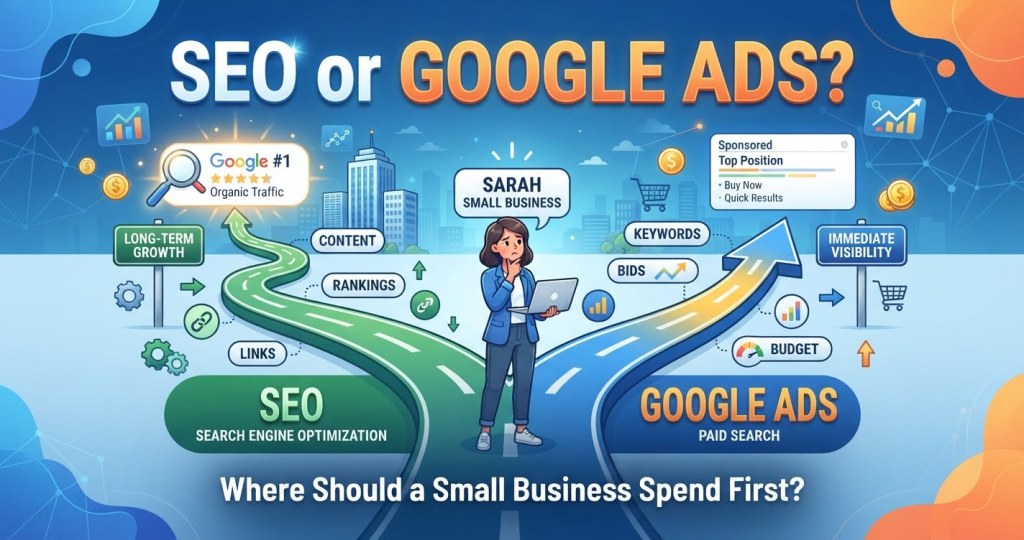


Every small business owner who wants more customers from Google eventually faces the same question. Should the marketing budget go into search engine optimisation, which builds free traffic over time, or into Google Ads, which can bring visitors the same day? Both work, but they work in very different ways. Choosing the wrong one first can mean months of wasted spending or slow growth when the business needed results quickly.
This article explains how each channel works, what it costs, how long it takes, and how to decide where to start.
How Google Ads Works
Google Ads lets you pay to appear at the top of search results for the keywords you choose. You set a daily budget, write your ads, and pay each time someone clicks. Campaigns can go live within a day, and you can turn them off just as quickly.
The biggest advantage is speed and control. You can target specific locations, times of day, and types of searches. You can test new services or offers and see within a week whether people are interested. For businesses that need enquiries now, such as a new clinic, a seasonal service, or a company launching a new product, ads are often the fastest way to get the phone ringing.
The drawback is that traffic stops the moment you stop paying. In competitive industries, clicks can be expensive, and costs tend to rise as more competitors bid on the same keywords. Without careful management, it is easy to pay for clicks from people who were never likely to buy.
How SEO Works
SEO is the work of making your website rank higher in the free, organic results. It involves improving the technical health of the site, writing pages that answer what customers search for, and earning mentions and links from other trusted websites.
The main advantage is that the traffic does not disappear when you stop spending. A page that ranks well can bring in visitors and enquiries every month for years. Many people also trust organic results more than ads, which can mean higher conversion rates.
The drawback is time. New websites, or sites in competitive industries, often need three to six months, and sometimes longer, before rankings and traffic grow significantly. SEO also needs consistent effort. Results come from many small improvements, not a single change.
Comparing the Costs
With Google Ads, the cost is easy to see: you pay for every click. If a keyword costs a few dollars per click and one in twenty visitors makes an enquiry, you can work out the cost per lead quickly and decide whether it is profitable.
SEO costs are mostly time or agency fees for content, technical work, and outreach. In the first months, the cost per lead from SEO looks high because traffic is still growing. Over a year or two, it usually becomes much cheaper than paid clicks because the same pages keep working without paying for each visit.
Questions to Help You Decide
Why the Best Answer is Often Both
Many successful small businesses use ads and SEO together. Ads bring in enquiries while SEO is building up. The data from ads, such as which keywords lead to sales, then shows which topics are worth targeting with SEO content. As organic rankings improve, the ad budget can be reduced or moved to keywords that are still hard to rank for.
This approach also protects the business. If ad costs rise sharply or a competitor starts bidding aggressively, organic traffic keeps coming in. If a Google update shakes up the rankings for a while, ads keep the pipeline steady.
Getting the Most from SEO
If you decide to invest in SEO, start with the pages closest to a sale: your main service pages and location pages. Make sure each one clearly explains what you offer, who it is for, and how to get in touch. Then add helpful articles that answer common customer questions, and keep your Google Business Profile complete and active.
For businesses without the time or skills in-house, working with a specialist can shorten the learning curve. A good agency, such as a team offering SEO Singapore services, should start with an audit, agree on clear goals, and report on enquiries and sales, not just rankings.
Getting the Most from Google Ads
If you start with ads, keep campaigns focused. Choose a small set of high-intent keywords, add negative keywords to block irrelevant searches, and send visitors to a landing page that matches the ad. Track calls, forms, and WhatsApp clicks as conversions, so Google can optimise for real enquiries and you can see your true cost per lead.
A Simple Example
Imagine a small renovation company with a modest monthly budget. In the first three months, most of the budget goes into Google Ads for a handful of high-intent searches, such as kitchen renovation and bathroom renovation in its area, while a smaller part funds SEO work on the website. By month six, the service pages start ranking on the first page and bringing in steady enquiries. The company then lowers its ad spend on keywords where it now ranks well and keeps ads running only for the most competitive searches. The total number of enquiries keeps growing while the cost per enquiry falls.
Final Thoughts
There is no single right answer for every business. Google Ads is the faster tap you can turn on and off, while SEO is the asset that keeps paying off over time. Start with the channel that matches your timeline and budget, measure results carefully, and add the other as soon as you can. Over time, a business that uses both well will usually get more customers for less money than one that relies on either alone.




Leave a Reply