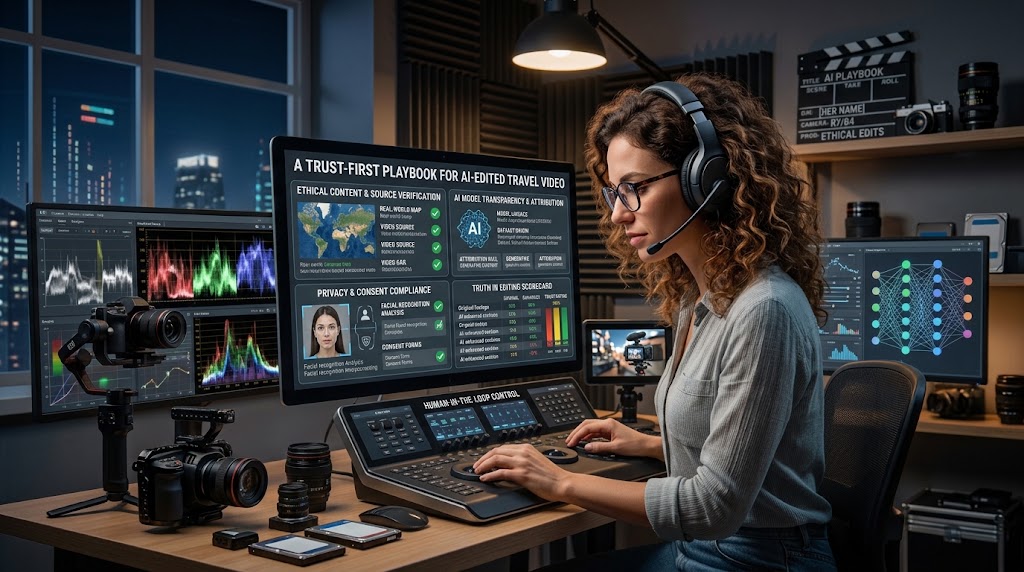


Travel video asks viewers to believe more than they may realize. A hotel-room tour implies that the camera entered that room. A beach clip suggests current conditions at that location. A presenter beside a landmark appears to have been there. These assumptions give travel content its persuasive power, but they also make careless synthetic editing risky. AI can now change a presenter, animate an original character, or create visual variations without a new shoot. That is useful for small publishers and travel businesses with limited budgets. Yet its strongest use is not to manufacture a trip that never happened. It is to make real information easier to understand, adapt, and remember.
This matters even more when travel content intersects with cryptocurrency. A video about paying abroad, using a wallet, or booking through a new platform may influence both travel and financial decisions. Viewers need to know which parts document a real experience, which explain a process, and which are creative illustrations. A convincing image should never do the work of evidence.
Separate the Evidence Layer From the Story Layer
A practical travel video has two layers. The evidence layer contains material that must remain factual: the property, destination, route, price, availability, accessibility, payment process, safety conditions, and the creator’s actual experience. The story layer helps the audience follow that information. It includes narration, graphics, maps, captions, transitions, mascots, and reconstructed examples. AI character editing belongs in the story layer unless the audience is explicitly told otherwise.
Consider a video explaining how a traveler used a digital wallet to pay at a café. The evidence may include a real screen recording, the amount paid, the fee, the confirmation time, and a receipt with private details removed. An animated host can introduce the steps or translate the explanation, but it should not be shown completing a transaction that never occurred and presented as proof. Likewise, a synthetic presenter can explain how to compare accommodation options, but it should not deliver a first-person hotel review unless the creator genuinely stayed there.
This separation makes updates easier. When each claim has a source, a changed visa rule or redesigned booking screen can be replaced without rebuilding the story. The visual identity and pacing can remain consistent.
Use Character Transformation as a Production Tool
Character transformation is most defensible when it solves a real production problem. A creator may want a recurring illustrated guide instead of appearing on camera. A tourism company may need localized versions of the same approved demonstration. A conference organizer may want a mascot to introduce venue information across a short series. In each case, the source performance provides timing and movement while the transformed character provides continuity.
For teams exploring AI video swap tools, the useful question is not “How can we make this look completely real?” It is “What role should this character play, and what must the viewer understand?” A stylized guide can function as a host. An authorized performer can be adapted for campaign versions. An original avatar can demonstrate a packing routine, explain a wallet setup, or connect documentary clips. These uses add structure without pretending that generated footage records an event.
Permission still comes first. The production should own or license the character image, source footage, music, graphics, and voice. A recognizable person should not be inserted into a destination, endorsement, or transaction without explicit authorization. Disclosure does not replace consent; it only gives the audience context after rights have been secured. Keep a record of who supplied each file and what use was approved.
If an edit makes a real person appear to do something they did not do, changes the meaning of a real place or event, or creates a realistic scene that never occurred, label it plainly. “AI-altered presenter” or “illustrative reconstruction” is clearer than vague language about enhanced production. Put the notice where people can see it.
Build the Video Around Verifiable Moments
Trustworthy travel content starts with a claim sheet, not an effects menu. Before editing, write down every statement that could change a viewer’s decision. Prices, opening hours, transport schedules, entry requirements, refund rules, exchange rates, network fees, and local restrictions all need a source and a date. If a fact is likely to change, say when it was checked. A polished clip cannot make stale information current.
Plan the video in short visual beats. Open with the question the traveler is trying to answer. Show the presenter briefly, then move to material that proves the point: a map, live interface, original location footage, signage, receipt, or quoted policy. Return to the host to interpret it. This rhythm prevents a synthetic face from dominating the screen and gives the viewer something concrete to evaluate.
Short source clips generally produce cleaner transformations than long, complicated takes. Use one visible subject, steady framing, even light, and movements that are not hidden by crowds or fast camera swings. Match the framing of the character image to the reference performance. Before generating a full sequence, test the hardest moment: a turn, a hand crossing the face, or a change in lighting. If it fails, simplify the shot or use a cutaway.
Sound deserves equal attention. Record narration in a quiet space, pronounce place names correctly, and leave room for pauses. Edit automatic captions carefully, especially currencies, wallet names, addresses, and local terms. On a phone, keep text large and away from interface controls. Travel video is often watched in transit with the sound off, so captions are part of the experience.
Make the Final Review an Editorial Review
The last check should ask more than whether the character looks stable. Watch once for visual defects, once for factual accuracy, and once as a skeptical traveler. Does any shot imply that the presenter visited a place when they did not? Could an illustrative payment be mistaken for a real transaction? Is an old price shown without a date? Does the title promise a review while the video offers only a general explanation? These are editorial failures even when the generation is flawless.
Keep the original files, consent records, fact sources, scripts, captions, and final exports together. If the platform supports content provenance or altered-media labels, preserve and use them. If a destination rule or payment detail changes, correct the description and replace the affected segment rather than leaving a beautiful but misleading video online.
AI editing can give small travel teams a consistent host, more language versions, and a faster way to turn one authorized performance into a useful series. Its value is greatest when the audience can still tell what happened, what was demonstrated, and what was imagined. In travel media, credibility is not a limit on creativity. It is what allows creative work to influence a real decision without betraying the person who trusts it.




Leave a Reply